Hoodoo 500: 19 Hours Off Recumbent Course Record
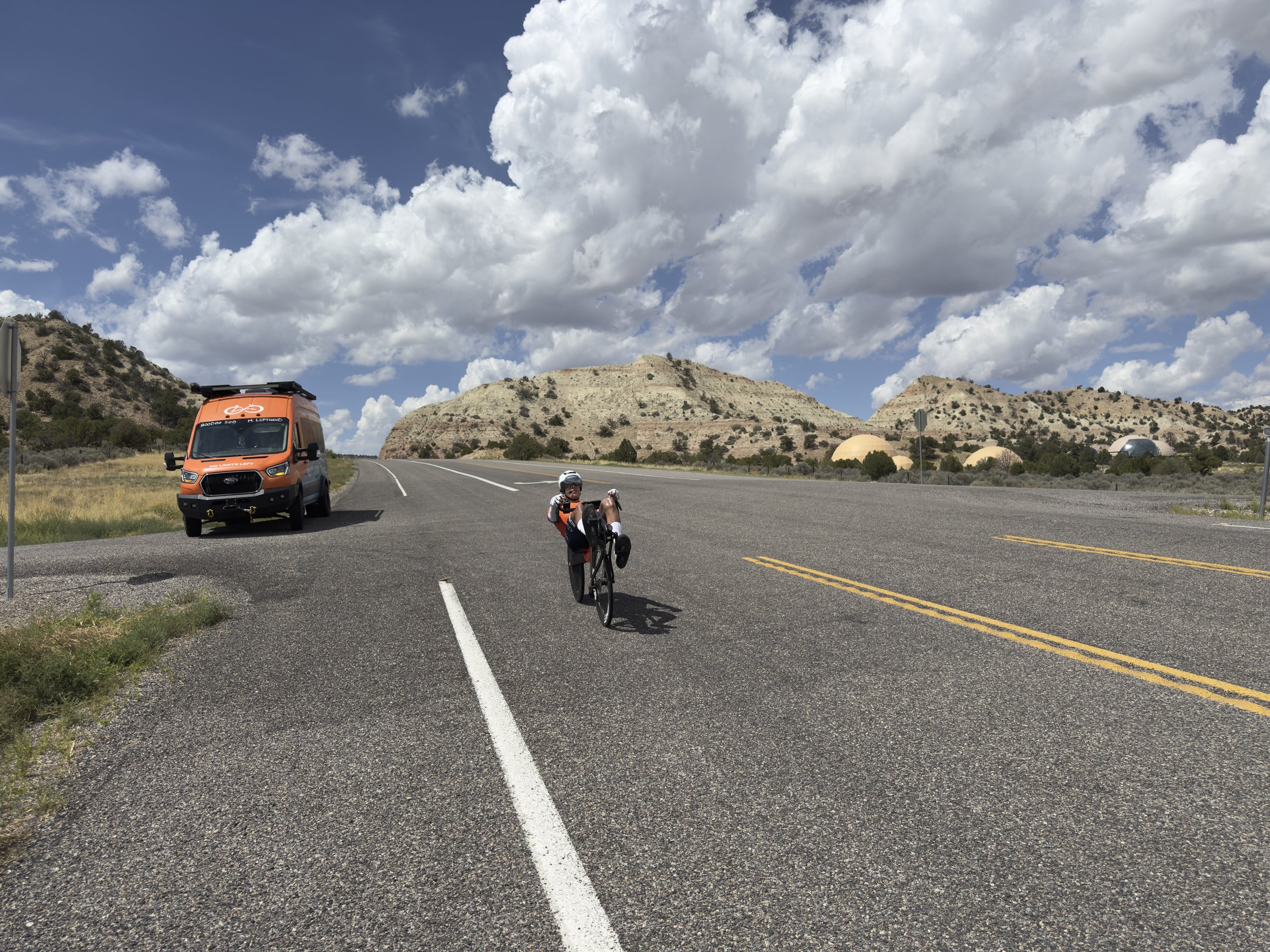
In a couple weeks, I will have been riding my Cruzbike V20c for a year. In that time, I have set course and world records on it, literally riding it all over the USA. But the Hoodoo 500 was set to be my greatest challenge on the bike yet: 500 miles and almost 30k feet of climbing.
In 2024, I raced Hoodoo for the first time and set a course record by 6 hours, coming very close to the fastest time on any version of the course (in the past, the course has been shorter with less climbing). In 2025, I came back with a year of ultra racing on my uprights under my belt and broke my own course record by 4 hours.
In 2026, with only a year on recumbents, I was able to answer the question of how the Cruzbike does on a climbing ultra course.
Before I jump into the race details, some important race prep. Having several ultras under my belt and coming to a place where I know what I’m doing, general prep was smooth and easy. However, I recently decided to switch to a TRP/Classified drivetrain. I am very excited about this gear change, and it honestly worked PERFECTLY during the race. But I only got the bikes set up in the couple weeks before the race, which meant some stress and a couple of race-day snags.
This is also a good point to mention my amazing crew. Bailey is my partner in life and the best crew chief a rider could wish for. My dad has now driven the vehicle at three Hoodoo races in a row and is always an amazing support. We also had Brian Milton along for the ride and enjoyed having an extra helping hand.
This dream-team crew had their work cut out for them. Getting my bikes switched over days before the race meant we did not have time to work through all the snags that come with such changes.
After my last test ride on one bike, I taped the wires between the shifters in place (run externally for now) and didn’t realize I had pulled them out of the connection. My crew could not get the bike to shift. Luckily, Trent at TRP was able to take their call, help troubleshoot the issue on the fly, and get it up and running. This ended up being HUGE later because we had flats that would have slowed us way down without another bike ready to go.
The flats presented another problem. The Classified system needs a special hub, and my spare wheels did not have all the parts yet, so my crew would need to move parts between wheels if I flatted. I wasn’t too worried because I had never had a flat on this course. But I was glad I showed my dad how to do it because we ended up with two.
I initially thought I wasn’t running enough pressure in my front tire (Cruzbike is front-heavy), but after the race we discovered that the newly built wheels were likely losing pressure. More on that later.
Now let’s get into the race.
It’s 7 a.m. on a mild summer day in southern Utah. The winds are looking great, and I’m feeling good. My plan is 150g/hr of Formula 369 in a 950ml bottle. I have Silca wax on my chains and Silca sealant in my tires. Thanks to Cycling Upgrades, we have the tools, spare parts, and other gear we need to make it 500 miles.
We pull away from the start banner and have several miles together as a group before getting on the highway and starting the actual racing. I chat with another 500 rider who travels to do one race per year and tell him about the Cruzbike. Everyone looks ready to go, and I’m excited to settle in for the day.
As the racing starts, I ramp up my pace and get to work. To my surprise, another rider is keeping up (not drafting). He must have been doing some serious work because we were moving along fairly well.
I really enjoy the start of this race because it’s fairly flat and gives you some time to settle in for what will be many hours of hard riding. Eventually, the 300 rider pacing behind me pulls ahead and rides off down the highway. I was impressed knowing how hard he must have been working, but also wondered how he was going to do.
He ended up winning the 300 race but was a couple hours off Adam’s record time last year. Adam did a fabulous race but was not that fast off the start. I believe pacing is a crucial skill in ultra. Some short-term choices really change the long-term outcome.
After getting into Hurricane, I was shuttled by my crew to Colorado City. During the shuttle, I changed a setting on my tracking GPS to reduce the audio alerts and checked in with my crew. Everything was still on plan. I was feeling great, fueling was ideal, and the bike was humming along.
After the shuttle, it was right back to work. Some climbing started, but most of the beginning of this race is shallow uphill. The first fast descent was coming, and I was excited to work more on my descending. It has been getting better, but it’s still a skill I’m developing on the Cruzbike.
During that descent, I held over 40 mph and got close to 50. I felt comfortable and enjoyed it. Then it was time for the long gradual uphill on Highway 89 toward Panguitch/Bryce. We had a decent tailwind and moved along nicely.
So far, everything was going according to plan. My stomach felt good, and the bike and I were in rhythm. As I turned toward Bryce, there was a lot of crosswind, but my time on the bike made it manageable. I stayed on the disc wheel and kept moving.
For those who don’t know, there are many ways to participate in Hoodoo, including a stage race. You stay in Escalante the first night and Panguitch the next. It splits the course up nicely and is an excellent way to experience the event. You should come and do it!
After Escalante comes my favorite part of the race, with beautiful canyons and rock formations on the way to Boulder Mountain.
Which brings me to the first real test of the race—and when things started to get hard.
From the city of Boulder to the summit is 3,500 feet of climbing. Much of it is gradual, but the second half pitches up. I had set up a lighter Cruzbike specifically for climbing and was excited to get on it.
Unfortunately, I had not tested the headrest or seat enough. My lower back experienced a lot of pressure, my head was not supported well, and climbing on a recumbent is already a challenging position because of the seat angle. This led to me doing less power than planned, eating less because of an upset stomach, and starting to develop some pain.
However, I made it to the top and was excited to try more descending. This descent is long and fast. In fact, I hit my top speed of 58.4 mph on it. More importantly, I felt very stable and comfortable.
At this point, I was still over 1 mph faster than my previous year and was confident the rest of the race would go well.
Little did I know, some challenges were coming.
I stayed on my second bike for another climb, which made my back pain worse. I wasn’t too worried because I only planned to use it one more time for the other big climb. However, my primary bike was about to get its first flat and put me back on the second bike while my crew fixed it.
The flat happened while riding over an especially bumpy cattle guard. My phone even flew off the mount and crashed to the ground. I stopped to get my phone and then realized my front tire was losing air.
Luckily, my crew got me on my second bike, and I rolled on while they dealt with the wheel.
In the moment, I was thrilled the bike switch worked so well, but I didn’t fully comprehend how much the second bike was affecting me. Even though I switched back quickly and decided to use the primary bike for the next long climb, some of the damage had been done.
We rolled on and made it to Panguitch. Thunderstorms were flooding Bryce Canyon in the distance, but they mostly missed us. I was rained on once, but it didn’t last long. There was also a good chance of rain over the next climb, but luckily weather never became a major challenge.
The climb from Panguitch to Cedar Breaks/Brian Head is 4,500 feet over about 30 miles. In other words, it’s not very steep, but it is very long.
I was handling it fairly well and keeping a steady pace. Honestly, I was excited to get it done because I knew if I could make it over, I could finish the race pretty strong. The night and climb were taking it out of me, though, and I was feeling more tired than I had in a long time.
In the last quarter of the climb, there are some steep sections. I asked for a new bottle, and my crew pulled beside me to hand it off. We had just hit a steep section, about 10–11%, and I knew it was too steep for a bottle handoff.
But I wanted to try and grow more skills.
I pushed myself too far and put everything at stake.
As I reached to hand my empty bottle to the car, I lost control and fell onto the side of the van. As I continued toward the ground, I used my whole body to move away from the van and keep from falling under the vehicle. The slow speed helped keep it from being more catastrophic as I hit the fender and tire on the way down and ended up lying on the ground behind the tire.
Bailey instantly thought I had been run over.
As I was lying there, I thought about how I could have been, so I tried to yell that I was okay. While I did not get crushed, I landed hard on my shoulder blade.
As I stood up and took some breaths, we all tried to gather ourselves. I wanted to get going again, knowing I was not terribly injured. I also did not realize how deeply Bailey had been impacted. Brian helped me get started, and I was back on my way to the top.
It’s an interesting blend of skills and toughness that are needed to be competitive in ultra. One of those skills is knowing when you need to stop and pause and when to carry on.
With my race mind on, I knew I wanted to get back on the bike and keep going. The downtime would just allow everything to set in and make it that much harder to start again and find a rhythm.
However, this race skill does not transfer over to every life moment.
The situation my wife was in was very different than mine. She was not in some physical battle with herself or me. She was trying to care for me and help me get to the end safely. Seeing me lying under a car at 2 a.m. with 6 hours to go was not a good place for her.
Since the race, Bailey and I have connected and cared for each other, but this moment had both a significant immediate and lasting impact. We have learned time and time again how to be safe and fast. This experience certainly taught us a lot, and we are glad the physical impact was minimal.
With less than 20 minutes of climbing left, we reached the point where my van had to enter Cedar Breaks. We stopped right before entering and got me into cold-weather clothes for the long descent ahead. It must have been near 50 degrees and maybe into the 40s—not terribly cold standing still, but certainly cold at speed.
I was quickly back on the bike and headed to the top. Shortly after my van left me, my front headlight decided it was a good time to announce its battery was getting low. It put itself into low-power mode and became much less bright. Not great when I’m descending toward Brian Head.
After re-establishing communication with my support vehicle, I got another headlight from Bailey and started the descent. I decided to take it carefully. I was already banged up and tired.
The next 60–90 minutes were mostly just riding my bike. My speed was still decent but not what it had been earlier. My lower back hurt from all the climbing, my upper body was tired from falling, and I was more tired than I usually am overnight in a race like this. The stress of the weeks before the race was catching up with Bailey and me.
One notable moment: I took another bottle from the car without incident.
It’s pretty typical after something happens to avoid that thing for a while, but I find it mentally reinforcing to lean back into it and conquer it before you give it space in your mind to become a fear. The same thing has happened when I have broken bones on my bike. It’s important mentally to get back out there and not let the fear grow.
We made one more stop around Cedar City. My plan was for this to be my last stop, but the night had a few other plans for us. I took off my cold gear and changed my condom catheter, which had come loose.
Then I was back on the move.
My stops were less like NASCAR pit stops than they normally are. I was moving slowly, and it felt hard to get going again, but I was still doing it. I was also hopeful I could bring my average speed back up and beat my time from last year.
As I left my crew, I felt pretty good—a little cold in the night air, but overall good. Hoodoo has changed its rules to allow riders to be alone at night since lights have grown so much brighter. I made my way into the dark and soon saw a rider ahead of me. I figured it was a 300 unsupported rider and started making my way toward their blinking lights.
I passed them with some speed, but shortly after there were cows on the road, including one huge cow right in the middle. I steered around it, got back up to speed, and started wondering where my crew was because it had been a while.
As I glanced at my phone, thinking about calling or voice-texting them, I looked up to see a stop sign quickly approaching. I know this course so well and had been navigating great, so the intersection caught me by surprise.
I slowed quickly to turn, hit a patch of gravel, and went sliding at a fairly low speed.
My arm was scratched, but I was okay. Mostly, I was upset with myself for losing attention. There also may have been a tire-pressure issue at play, which I’ll get to.
I got back on and shook it off. That was twice on the ground within a few hours, and I was bummed, but I just wanted to get back to it.
This was going to be a fantastic end!
I started using all the mental tricks to get myself back into a good headspace.
Then, coming into another intersection, I was riding in the car lane because the shoulder was messy when—boom—my front tire bottomed out on a pothole. My phone went flying again, and my tire instantly lost air.
The Cruzbike is hard to control with a front flat; I have a large scar on one arm to say so. However, I controlled it to a stop even from a fast speed and looked back for my phone about 50m behind me.
Luckily, my crew car was pulling up just then. I told them my phone was sitting in the middle of the lane.
Oh, and I needed to switch bikes again. Ugh.
They got my phone, brought up the new bike, and got me back on my way.
The problem was that the internal parts of the Classified hub were only in two of my wheels, so putting on another spare meant moving those parts from one wheel to another. It’s a simple process when you know what you are doing, but it takes specialized tools and some bike-mechanic knowledge.
Luckily, my dad is an excellent mechanic and had been willing to learn the process the day before the race. I had felt sort of silly teaching him because I had never needed a spare wheel on the road at Hoodoo.
Now we were on spare wheel number two, and I was beyond glad we had gone over it.
It also meant my crew was doing all of this in the dark, including removing the front wheel from the Cruzbike, which is a bit of an exercise on its own. This second time they struggled and it took a while.
I am so grateful for them. They made the race happen.
Here I was, finishing slower than expected and starting one of the last climbs. Sure, I was on the climbing bike, but my comfort on that bike was bad. Thankfully, I had thought to bring the pad from my primary bike over to the secondary bike, which helped, but a lot of the damage and pain was already done.
I made it over that long gradual uphill after what felt like ages.
Then it started raining.
I descended very slowly. Luckily, the rain was not heavy or I would have gotten cold very quickly, but it was enough to make the roads wet and hurt my confidence.
Somewhere in this section, I decided my new goal was simply to make it to the finish without another incident. My crew had been through the wringer, my body was hammered, and my mind was feeling it.
The one thing I had to look forward to was sunlight.
But first, I had the last significant climb.
I had built this climb up in my mind more than usual and was not excited to get back into a climbing position. However, I took it on with as much strength as I had left and accomplished it with some grace.
At the top, I was finally able to switch back to my primary bike for the finish. I was so excited!
You can tell how tired I was because I walked with my bike, my wife rubbing my back, for about 40 feet before I finally got myself back on for the remainder of the ride.
I knew much of it was downhill and all I had to do was get back, but man, was I exhausted. More than I had been in a long time.
As expected, it was ripping fast toward the end. For much of it, my crew was close by and we could talk over the radio. We joked, chatted, sang songs, and tried to pass the time.
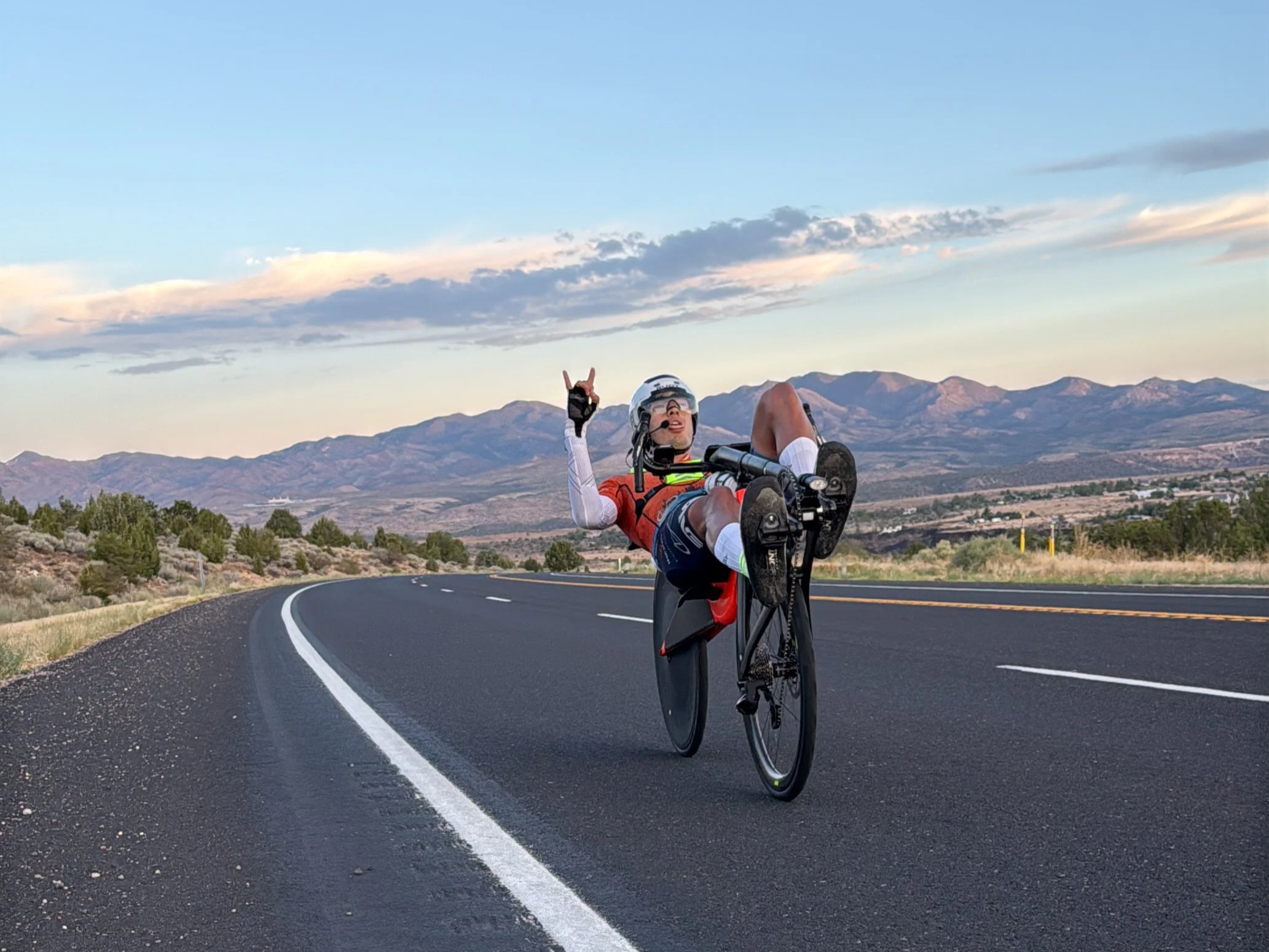
The sun was up, and I was feeling alive again for the first time in a while.
But when I tell you my back hurt, I mean it was pretty beat up.
There is a little town called Veyo at the foot of a dormant volcano. The kicker to get out of town is not long, but it was enough to remind me that my tailbone did not feel good at all. I knew getting over it was the last real challenge.
Getting to the top was a state of euphoria.
In reality, I still had about an hour on the bike, but that felt like nothing after the war I had been through. As I turned to go down Snow Canyon, I started to feel the weight of finishing come off my shoulders.
I started to reflect.
Although this year had presented many challenges, we had not only overcome them but still produced a very fast time in the face of all of them. I was pleased. I was ecstatic with my crew and so thankful for their amazing support.
I had also learned a lot about the Cruzbike on a course like this and had plans to make it go better next time.
That’s right. People wanted to know if I would do Hoodoo again on the Cruzbike, and it was obvious to me: yes, I will be doing it again, and it will be so fast.
Realistically, if we were more prepared, we could have been a couple of hours faster.
Before I knew it, I was at the line with family and friends there to cheer me in. Thank you, Ryan Collins and Chris Stevens, for coming out to say congrats—and a massive congrats on your speedy run of the course together.
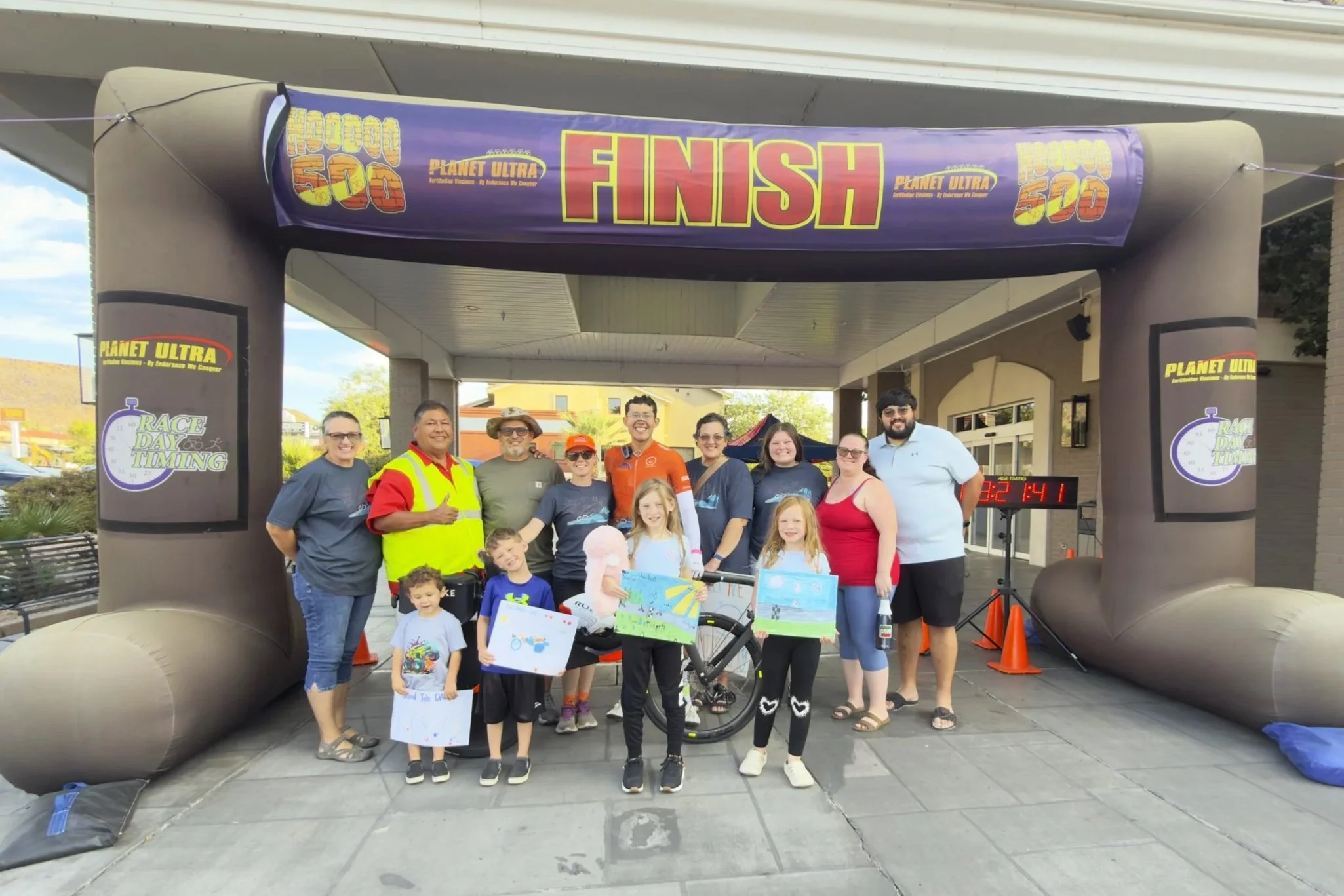
Thanks to my family for helping with my children, crewing me, and showing up for me time and time again.
I hugged my wife.
Nothing like the hug I would have with her later in the Airbnb kitchen after telling her how sorry I was for the accident on the hill.
Bailey is as special as humans get. She is capable, smart, kind, caring, and the right mixture of selfish and selfless. I am honored to have her as my partner in life, sport, and parenting.
Deb is a hoot, and I love this event because of her.
Look, if you have read this far, you love this stuff. It’s time to come to Hoodoo. Sign up next year and be there. You will have the time of your life.
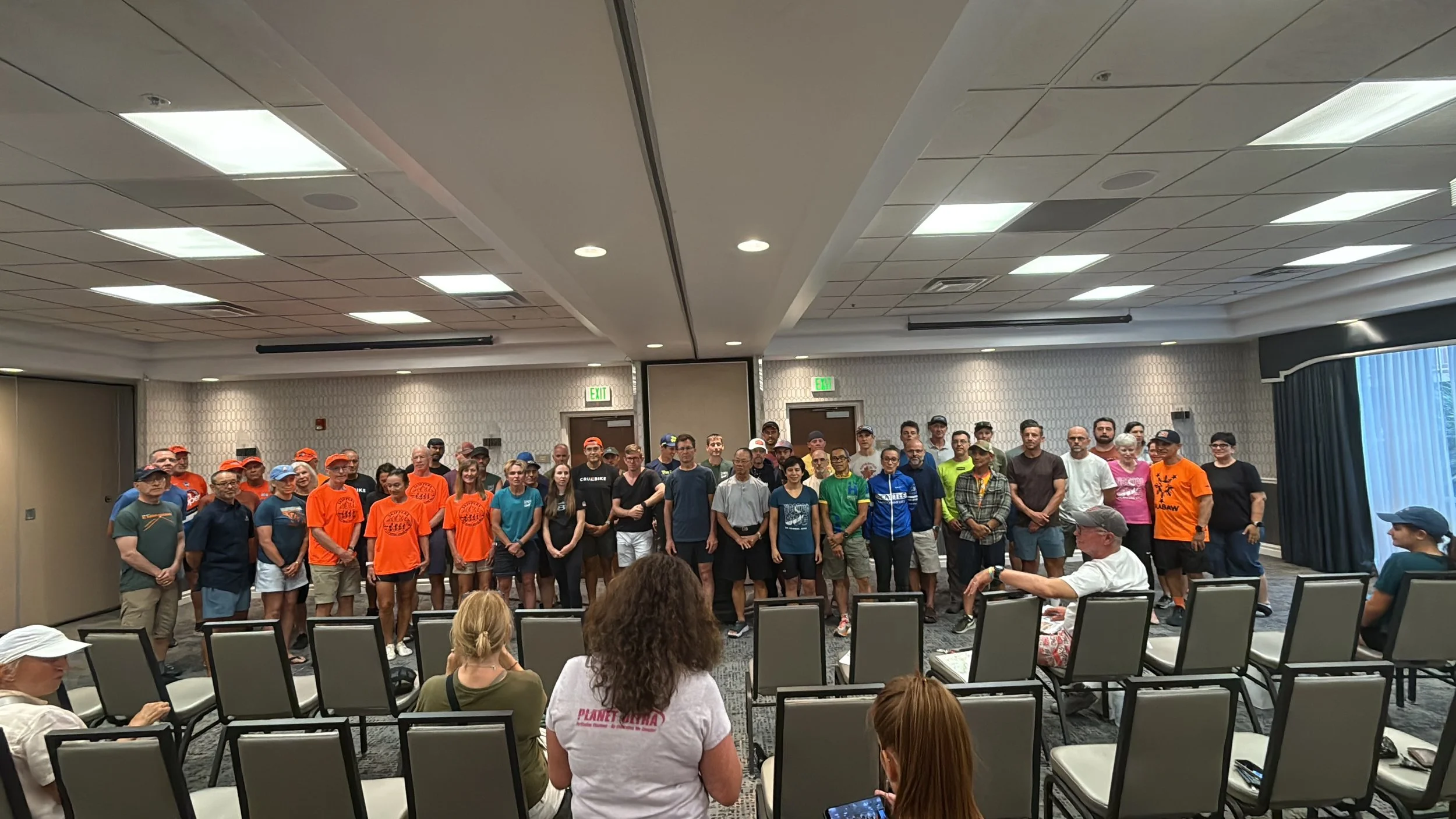
You can ride 300, 400, or 500 miles nonstop, do the 300 or 500 as a 2- or 3-day stage race, or do pretty much any of those as a team. Get some people together and make this happen.
It’s seriously the best race on the USA ultra calendar.
Okay, one final note about our tire issues.
At the finish, I was convinced I simply needed wider tires to prevent the rim-bite flats I experienced on big bumps. What I realized later makes me sad that we didn’t catch it before the race, but it is what it is.
To run the new Classified system, I had my ENVE wheels rebuilt with new hubs. That meant new tape and valve stems, and I believe the new valve stems had not completely seated and sealed. Normally, after several rides I end up tightening them to make sure they are secure and not causing air loss.
I think all my front wheels were slowly losing air while riding.
The evidence? My crew noted that my tires were low each time they checked them. They thought it was elevation. But after the race, the last tire on a newly built wheel lost pressure while sitting in the van. I tried to air it up, but it lost pressure again. This time, I could hear the air escaping inside the rim.
I tightened the valve stem, the leak stopped, and it has not lost pressure since.
So I believe my flats were related to my gear not being fully ready for the race because of all the changes.
Let me be clear: not because of the new gear or the old gear, but because we lacked setup and testing time. Usually, I have all these things worked out before a race. This time, I didn't.
That’s it. That’s the Hoodoo 500.
I’m excited to share a video about this one with everyone—Stay tuned!
